
Technical Details and Context
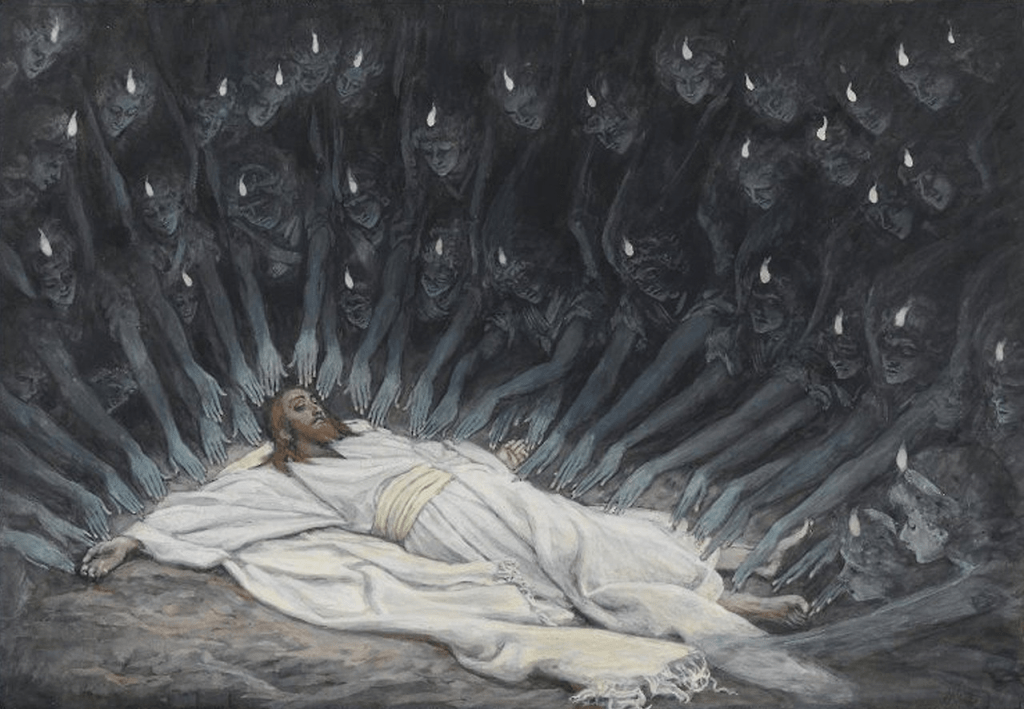
- Title: Jesus Ministered to by Angels / Jésus assisté par les anges
- Artist: James Jacques Joseph Tissot (known as James Tissot)
- Date: between 1886–1894
- Medium: opaque watercolor (gouache) over graphite on gray paper
- Dimensions: 17 × 24.8 cm (6 11/16 × 9 3/4 in.)
- Location: Brooklyn Museum, New York – acquired through public subscription in 1900
Description and Interpretation
The work is part of the monumental series The Life of Christ (La Vie de Notre-Seigneur Jésus-Christ), a colossal visual project of about 350 watercolors, created after a religious vision the artist had in 1885. Tissot traveled to the Middle East (1886, 1889, 1896) to study scenery, costumes, and landscapes, aiming to give historical accuracy and biblical authenticity.
In Jesus Ministered to by Angels, Tissot depicts Jesus in a moment of vulnerability — collapsed, perhaps, after the forty days in the desert, but surrounded and supported by angels. The atmosphere is mystical, almost eerie: light radiates from the angels’ halos, contrasting with the surrounding darkness, which emphasizes both isolation and divine support.
Artistic and Theological Significance
Symbolism & Mysticism: The painting is often placed in the Symbolist style, since it emphasizes inner religious experience rather than literal representation.
Reception: The public was fascinated by the clean, authentic Oriental realism, but critics of the time were divided — some admired his documentation, while others found it too theatrical, even “over-explained.”
Visual Analysis
1. Light and Shadow Contrast
Jesus, clothed in a radiant white garment, sits at the center of the composition in a soft, warm light. The angels, by contrast, are rendered in cold, dark gray tones — almost corpse-like — evoking mystery and otherworldliness. This contrast highlights both Jesus’s vulnerable state and the supernatural intervention breaking through the darkness.
2. Posture and Gesture
Jesus lies stretched out, slightly slack, as if just emerging from an extreme trial. The angels’ hands reach toward him, but unlike many traditional depictions, they are not necessarily tender. Instead, they seem determined, austere, even pressing. Their “service” is suggested, but it’s a paradoxical service: dignified, ritualistic, full of authority.
3. Mystical, Hallucinatory Atmosphere
The Brooklyn Museum notes that Tissot’s style oscillates between rigorous naturalism and a “decidedly mystical or hallucinatory” aesthetic, close (in intent) to William Blake. Jesus appears exhausted yet almost ethereal, stretched between two worlds.
Historical Context and Artistic Project
The Life of Christ Project: Tissot devoted his later years to this vast watercolor cycle, 350 works in total, illustrating biblical scenes with archaeological attention to costumes, landscapes, and people. He traveled through the Middle East to study the terrain “on site.”
This work belongs to that cycle, most likely intended as the scene after the temptation in the desert, when “the angels ministered unto him” (Mark 1:13; cf. Matthew 4:11, Luke 4:14). Tissot depicts not just the event but the inner state — exhaustion, divine indulgence, absolute service.
Theological and Symbolic Interpretation
1. Human Vulnerability + Divine Support
Jesus, both God and man, appears weakened. This is a moment where his humanity — fatigue, suffering — is partially exposed. The angels come to serve him, to bring comfort. It’s a clear image of the idea that even the Son, in the limits of the body, received support — and more so, from heavenly beings.
2. Inner Darkness vs. Divine Light
The angels, painted in cold, shadowy grays, may represent aspects of the spiritual world that are not the comforting, luminous angels of tradition. Here, support is austere, solemn, mysterious, almost heavy with introspection. The light shining on Jesus is real, clear, but not festive. The focus is on sacred support, not triumphalism.
3. Re-activating the Scriptural Episode
The biblical text simply says: “the angels came and ministered to him.” It doesn’t specify how, only that they acted. Tissot takes artistic freedom to imagine them as shadowy-luminous presences, emerging not from outside but from the depth of spiritual reality. This is service, but it reminds us that religion is not always comforting.
4. Breathing Between Realism and Vision
Tissot fuses ethnographic realism (archaic costumes, authentic Middle Eastern scenery) with presences that feel fantastical. It’s a contrast between what is seen and tangible (realism) and what is unseen yet palpable (vision, the supernatural).
Conclusion
Tissot’s work does not aim to be a pretty “religious illustration” — it is a militant visual reconstruction of a moment of holy exhaustion, followed by a solemn, sacred intervention. The stark contrast between shining light and the heavy, almost oppressive angels pulls us out of comfortable religious imagery and confronts us with spiritual ambiguity: divine support is offered, but not always with smiles or angelic songs.
Join my Pateron here.
 Odettouchu